What is a 1-Second Spacebar Counter?
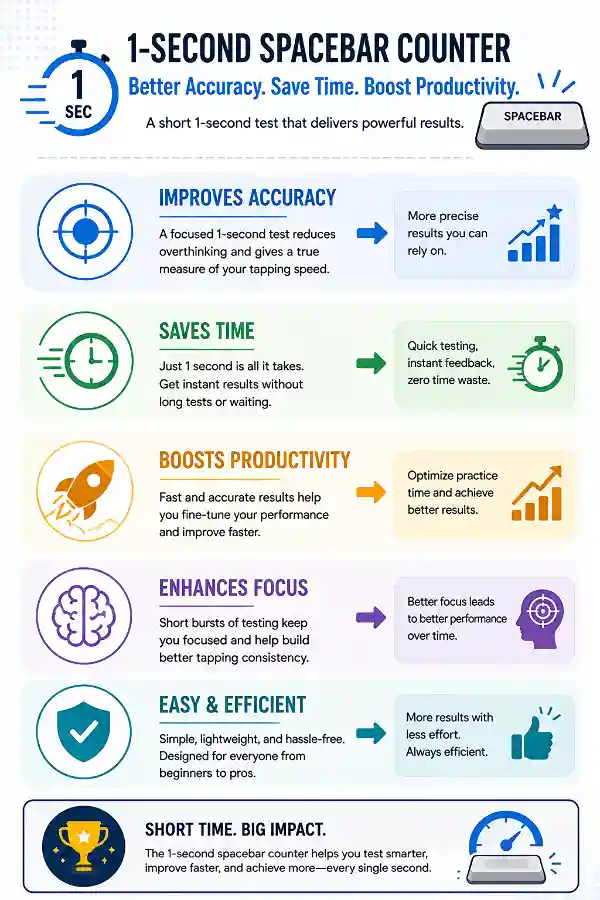
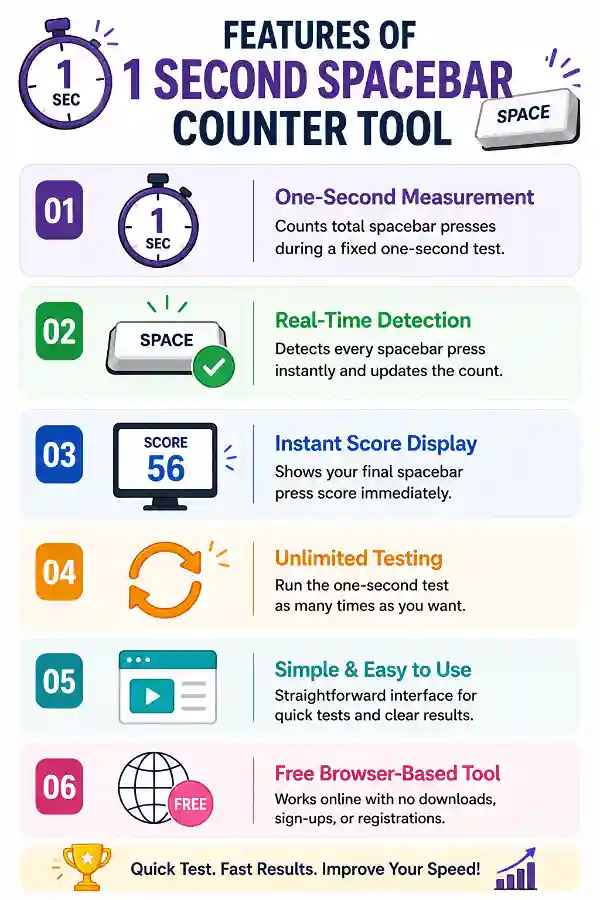
A 1-Second Spacebar Counter is a tool that measures how many times you can press the spacebar within exactly one second. It is designed for quick testing where users want immediate spacebar speed results. The tool records detected key presses and displays the final count instantly after the test ends.
How does the 1-Second Spacebar Counter work?
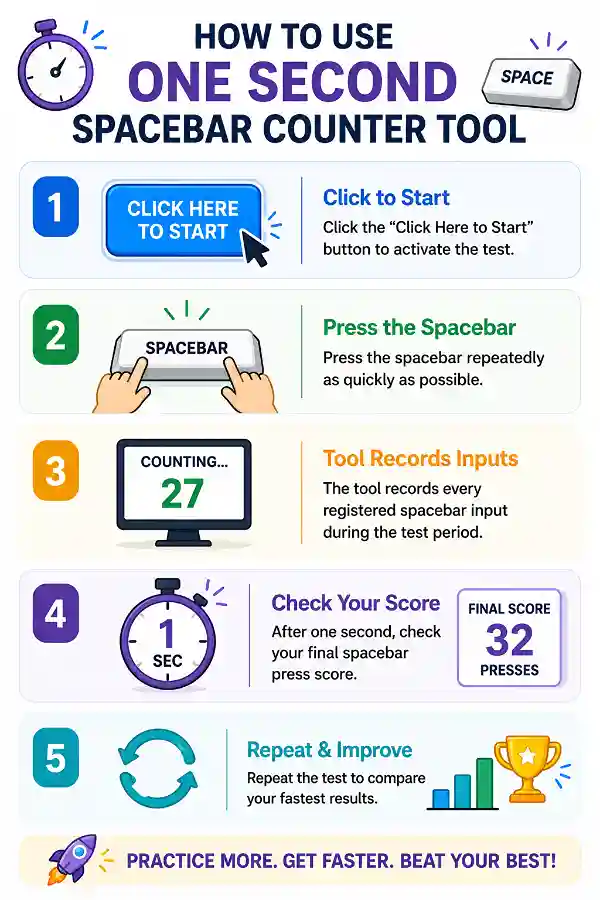
The test starts when you activate the tool and begins a one-second countdown. During this short period, every registered spacebar press is counted automatically. When the timer reaches zero, the tool stops recording and shows your final score.
Why use a one-second spacebar test instead of a longer test?
A one-second test focuses on maximum short-duration pressing speed rather than endurance. It allows users to measure their fastest performance without waiting for a longer session. This makes it useful for quick comparisons and instant keyboard checks.
What can I use the 1-Second Spacebar Counter for?
You can use it to measure rapid spacebar pressing speed, check keyboard responsiveness, and compare different keyboards. It is also useful for users who want a quick input test before gaming or other activities requiring fast key presses.
Can the tool detect every spacebar press in one second?
The tool counts every spacebar press successfully detected by your browser and keyboard. Results depend on your pressing technique, keyboard response, and whether the hardware registers each input. A properly working keyboard should provide consistent results.
Why is my score lower than expected in the one-second test?
A lower score can happen because of clicking rhythm, finger movement speed, keyboard response, or missed inputs. Since the test duration is very short, even one or two missed presses can noticeably affect the final result. Multiple attempts can help you understand your average performance.
Does the one-second test measure typing speed?
No, the tool only measures spacebar presses within one second. It does not evaluate typing speed, words per minute, or general keyboard skills. It is specifically designed for space key input measurement.
Why does my result change every time I take the test?
Small differences are normal because the test measures a very short time period. Your finger position, pressing rhythm, and reaction timing can affect the final count. Running several attempts can help you compare your most consistent results.
Can I use the 1-Second Spacebar Counter on a laptop?
Yes, it works with most laptop keyboards that have a functioning space key. However, laptop keyboards may feel different from mechanical or gaming keyboards. The results may vary depending on the keyboard design.
Does keyboard switch type affect the result?
Yes, different keyboard switches can provide different levels of feedback and response. Mechanical, membrane, and laptop keyboards may produce different results depending on their design. However, your pressing technique remains the biggest factor.
Is a higher one-second score always better?
A higher score shows faster repeated pressing during that specific test duration. However, it does not always mean the keyboard is better because accuracy, comfort, and consistency also matter. The result mainly represents short burst pressing speed.
Can this tool identify a faulty spacebar?
The tool can help reveal inconsistent spacebar registration by showing missed or irregular counts. However, it cannot diagnose internal keyboard components. Hardware inspection may be needed for serious mechanical problems.
Why does my spacebar make a sound but the counter does not increase?
The keyboard may physically respond while the browser fails to detect the input correctly. This can happen due to focus issues, connection problems, or browser behavior. Restarting the test or reconnecting the keyboard may help.
Does the 1-Second Spacebar Counter require any software?
No, the tool works directly in your web browser. You do not need to download applications, install extensions, or configure keyboard settings. It provides instant testing through normal keyboard input.
Can gamers use the 1-Second Spacebar Counter?
Yes, gamers can use it to quickly check keyboard responsiveness before playing. It is useful for games where repeated spacebar actions are required. The short test provides immediate feedback about key registration.
Can I improve my one-second spacebar score?
You can improve your score by practicing finger movement and maintaining consistent pressing technique. Repeating the test allows you to monitor changes in performance. Results may also vary depending on keyboard familiarity.
Does the tool work with wireless keyboards?
Yes, it can work with wireless keyboards if the connection is stable. Input delays, battery levels, or connection interruptions may affect the result. For accurate testing, ensure the keyboard is properly connected.
Can I run unlimited one-second spacebar tests?
Yes, you can repeat the test as many times as needed. Multiple attempts allow you to compare scores and check consistency. There is no need to wait between tests.
How accurate is a one-second spacebar measurement?
The tool accurately counts the spacebar presses that are detected during the one-second period. Because the test is very short, small input differences can significantly change the final number. A stable keyboard and consistent technique provide more reliable results.
What can I learn from a Typing Speed Test result?
A
Typing Speed Test shows your typing speed, accuracy, and overall keyboard efficiency. By using the tool, users can understand their current typing ability and identify areas that need improvement, such as speed, mistakes, or consistency. It is useful for students, professionals, writers, and anyone who spends time typing.
How do I know if my mouse buttons are registering correctly?
A mouse button problem may appear as missed clicks, delayed responses, or unexpected actions. Using the
mouse button test allows you to test individual mouse buttons and check whether every click is detected properly. It is useful when troubleshooting an old mouse or verifying a new one.